How a Rejected Set of Minutes Led to a Framework That Helps HR and Administrative Professionals Produce Board-Grade Documentation With Confidence
Let me ask you something directly.
Have you ever submitted meeting minutes only to receive pages of corrections?
Have you ever sat through the adoption of minutes and silently hoped nobody would identify gaps in your documentation?
Please. Just adopt them. Just let it go this time.
Or worse, have you ever presented minutes that were stepped down and not adopted because they lacked critical details, structure or sufficient documentation?
I have.
I once presented a set of management meeting minutes that I believed was ready. I had reviewed it carefully and felt confident in the work. Yet when the time came for adoption, the minutes were unanimously stepped down and sent back for correction.
Not because I was careless.
Not because I lacked commitment.
But because the document did not yet meet the standard expected of a governance record.
That experience was humbling. It also exposed a reality that many HR professionals, Administrative Officers, Executive Assistants, Secretaries and Governance Professionals quietly face every day.
Most of us are never formally taught how to produce board-grade documentation.
We are given responsibility for management meetings, committee meetings and board sessions, yet nobody teaches us what leadership expects to see in a professional governance record, how deliberations should be captured, how decisions should be documented, or how resolutions should be extracted.
As a result, even competent professionals often find themselves relying on guesswork. The consequences are familiar:
- Endless corrections and returned documents
- Minutes stepped down or rejected at adoption
- Delayed approvals holding up institutional processes
- Leadership frustration and reduced confidence in your work
- Weakened institutional memory across the organisation
- A quiet erosion of professional credibility, even when the effort behind it was genuine
The problem is not your intelligence. The problem is that nobody gave you a reliable system.
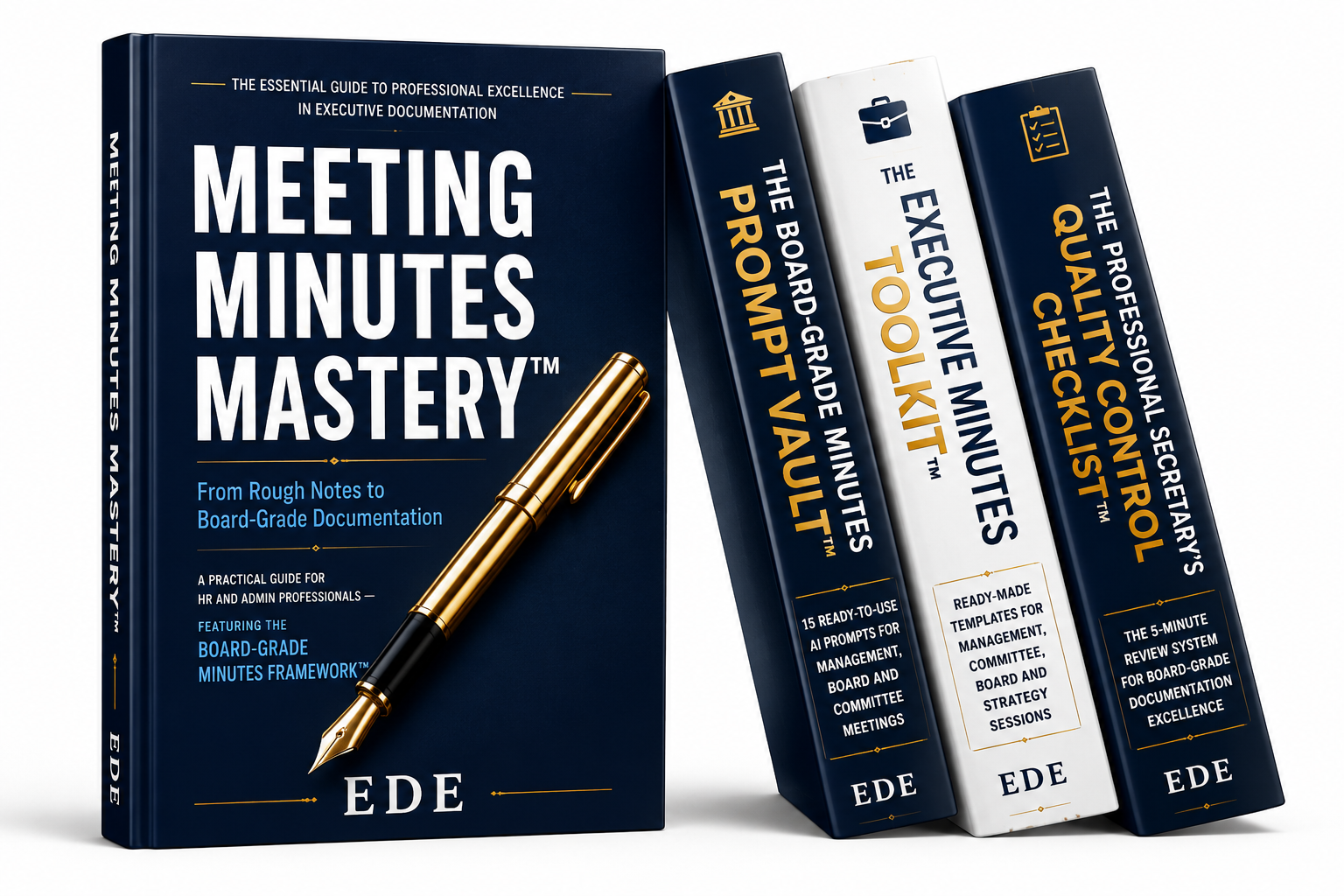
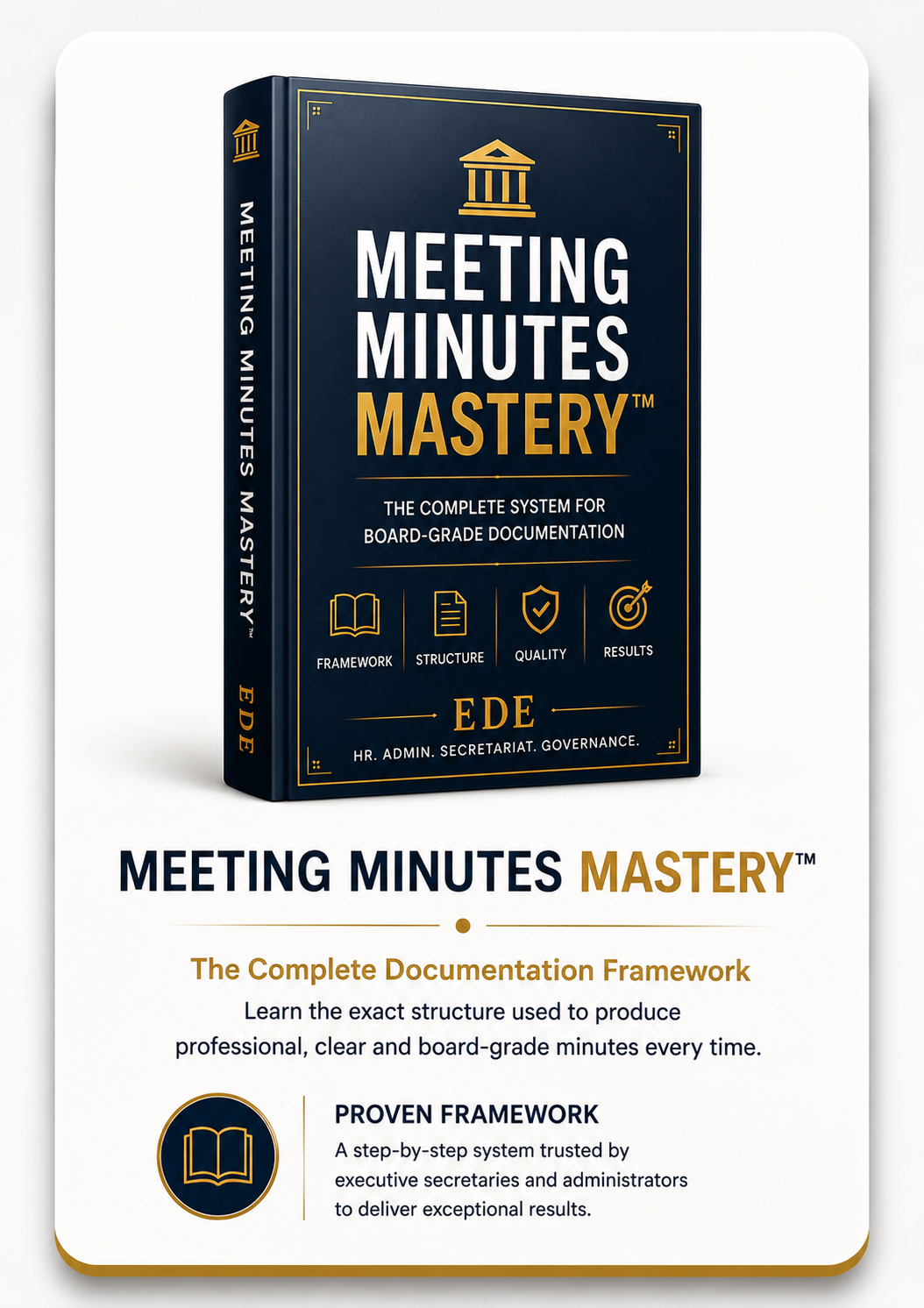
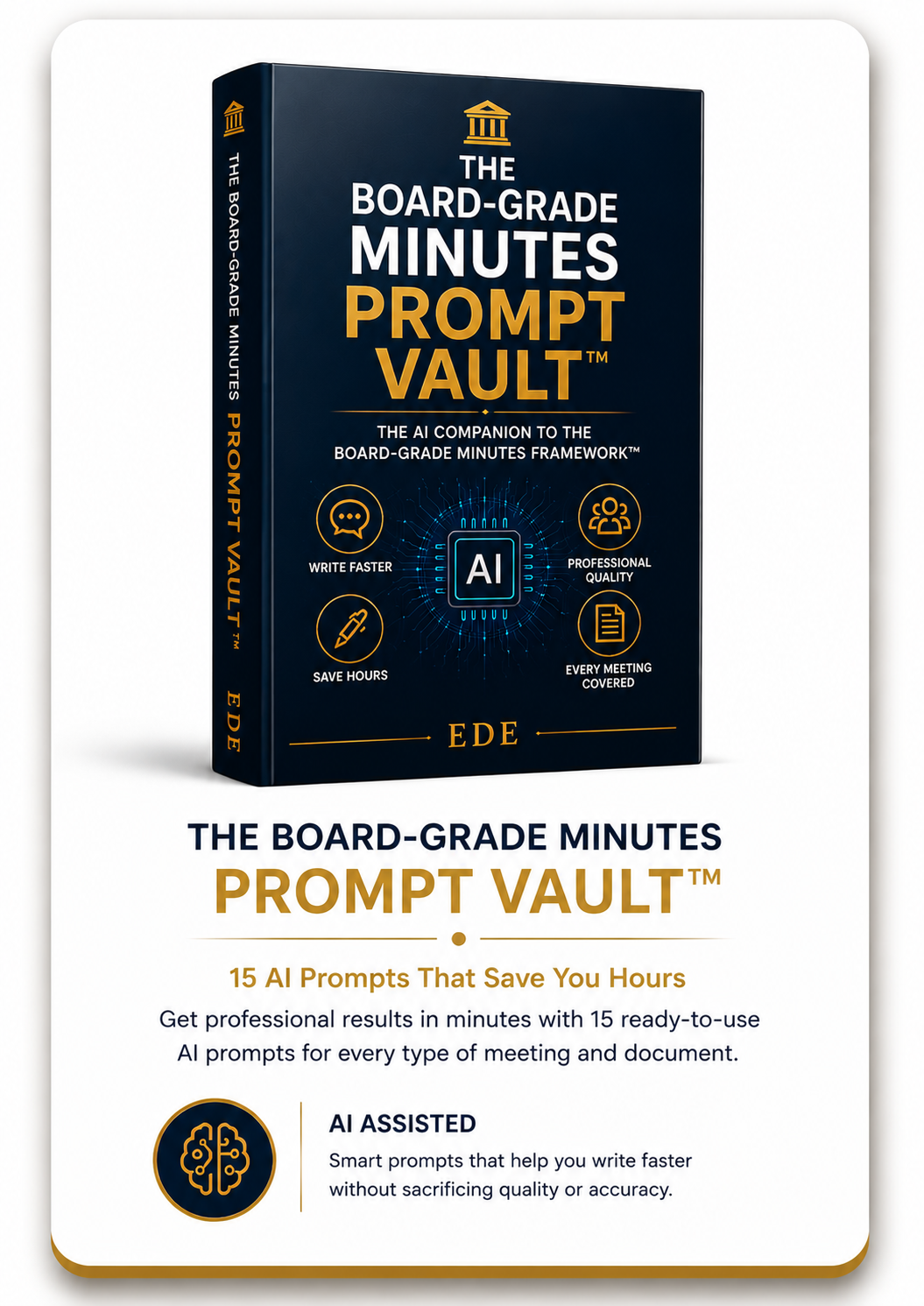
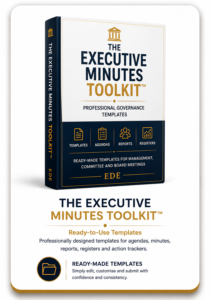
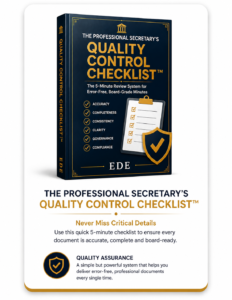
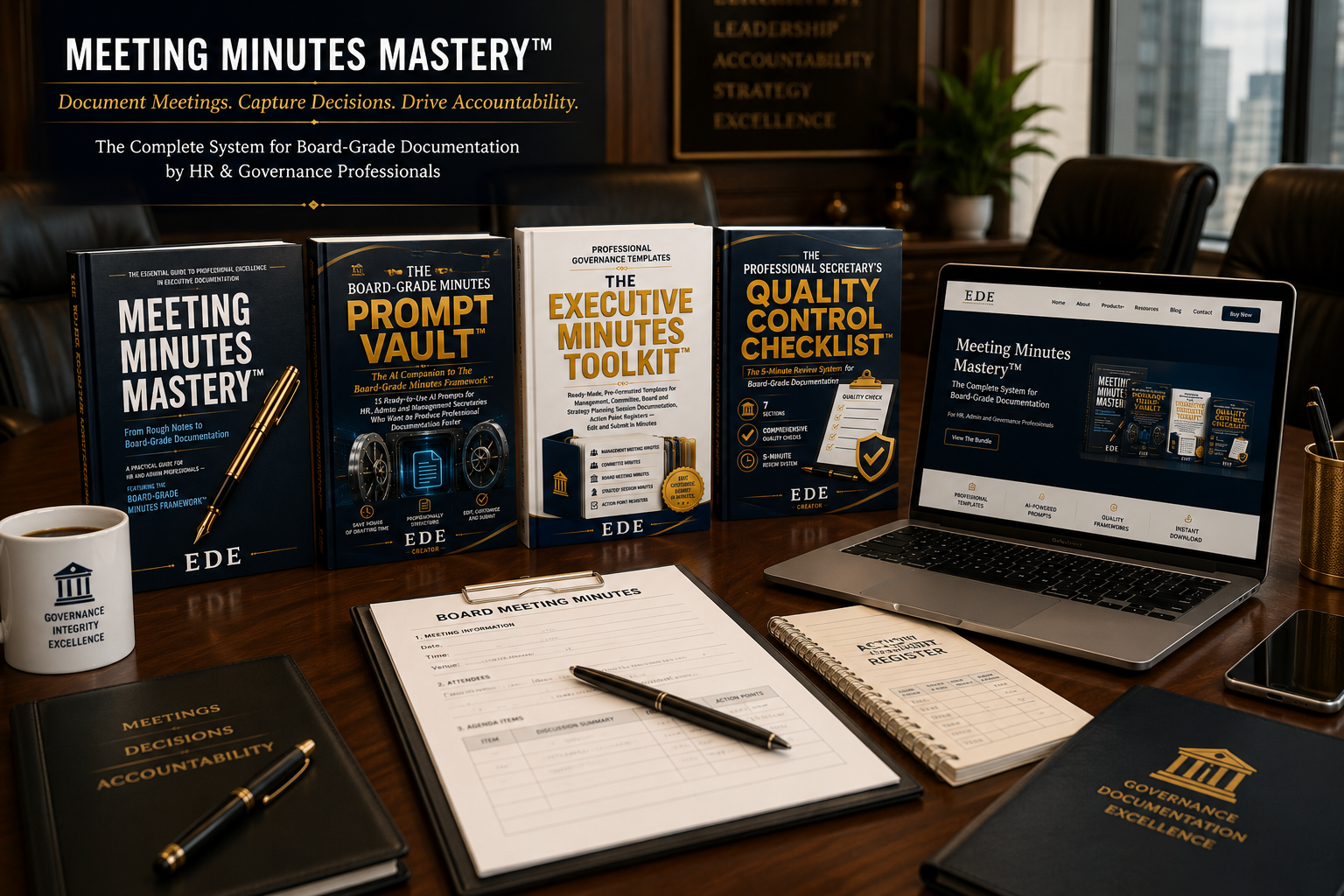
That's exactly why I built Meeting Minutes Mastery™. I'm about to share the framework, tools and system that transformed my own documentation practice. It's since been packaged into a complete professional bundle for HR, Admin and Secretariat professionals who are ready to move from corrected to credible.
About EDE
EDE
The ability to produce board-grade minutes is not taught in lecture halls. It is not covered in most HR induction programmes. It is not something organisations typically invest in training you for. And yet governance institutions, microfinance banks, corporations, NGOs and public sector bodies across Africa expect it from their HR and Secretariat staff every single time a meeting is held.
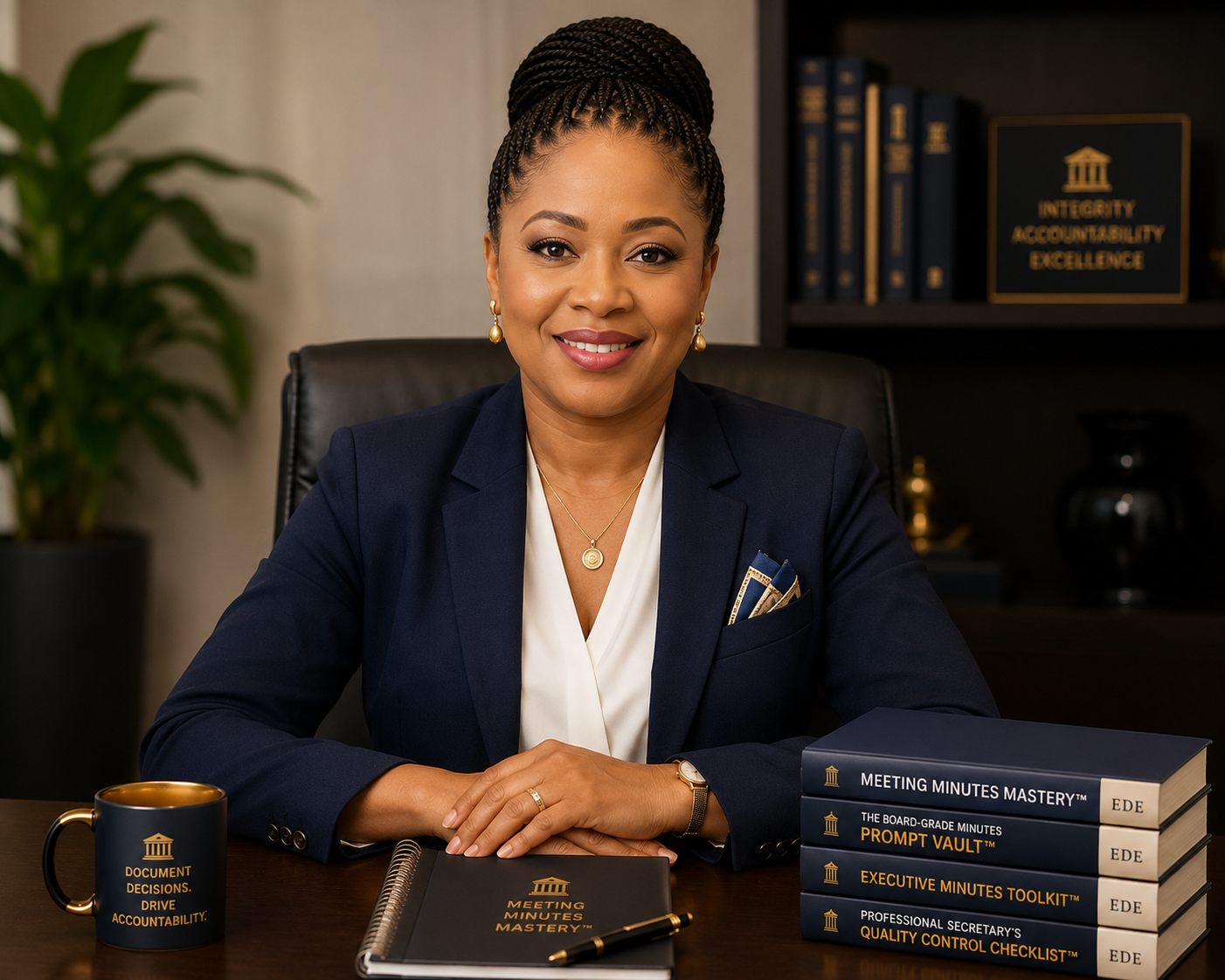
I am a Human Resources and Administration professional with practical experience supporting executive management, board governance processes, procurement administration and institutional reporting within the financial services sector. I am not a writing coach selling theory from a classroom. I faced exactly the kind of documentation crisis described above, and built a system to solve it.
How It Started
The responsibility came to me the way it comes to many HR and Administrative professionals in growing organisations. There was no predecessor to hand over to me, no documented framework, no formal training, no experienced administrator sitting beside me to explain what leadership expected from a professional governance record. It simply became mine.
Like many professionals in start-ups, growing institutions and resource-constrained organisations, I wore multiple hats. Alongside my core responsibilities, I was expected to coordinate meetings, document discussions, track decisions and produce minutes that could withstand management and governance scrutiny.
So I did what most people in that position would do. I relied on judgement: paying attention in the room, taking notes, organising the discussion as best I could, checking spelling, correcting names, making sure the document looked the part.
For a while, I believed that was enough. The document looked structured, the discussions appeared organised, the action points were there. Surely that was sufficient.
What I did not yet understand was that there is a significant difference between minutes that look professional and minutes that meet the standard of a governance record. A document can read well and still fail to capture the depth, context, deliberation and accountability that leadership expects from an institutional record.
I would eventually learn that lesson the hard way.
The Moment Everything Changed
When the time came for adoption at that management meeting, the Chairperson looked around the table.
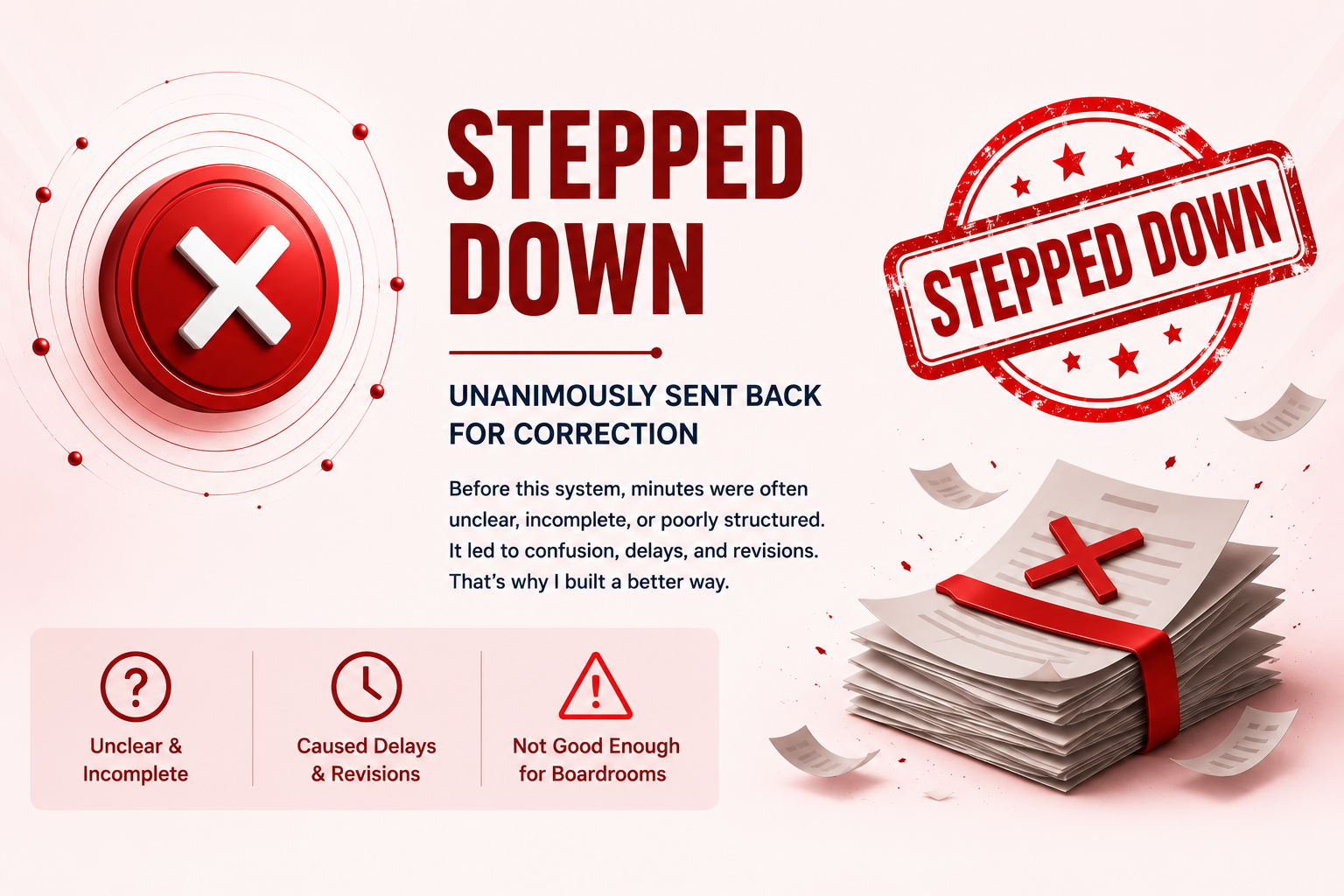
The formatting wasn't the problem. Neither were the names, all correctly spelled. The document simply didn't meet the standard expected of a governance record. Critical deliberations were missing, resolutions were vague, and the page captured what had been discussed rather than what had been decided. In governance documentation, those are two very different things.
I worked so hard on this. How did I miss it?
The answer, I would eventually understand, was not that I lacked effort. It was that I lacked a system.
Building the System
What changed wasn't a single conversation or a mentor moment. It was a slow, disciplined process: studying the gap between what I was producing and what the standard actually required, then building a framework to close it.
I studied governance documentation methodology, how deliberation flow works inside institutional records, and how resolutions need to be extracted and written down for them to function as a real accountability mechanism. Then I tested it. Refined it. Rebuilt it more than once.
Slowly, and at times painfully slowly, the quality of my documentation began to change. Corrections became fewer, then rarer. Eventually, the same leadership whose feedback had once stung began describing my work as board-grade.
I did not just improve my minutes. I built a framework that made producing board-grade documentation a repeatable process, one I could follow consistently regardless of the complexity of the meeting. EDE
Over time, that methodology evolved into what I now call the Board-Grade Minutes Framework™: a practical seven-stage system that transforms raw meeting discussions into structured, board-ready documentation. It is the same framework that sits at the heart of every resource inside Meeting Minutes Mastery™.
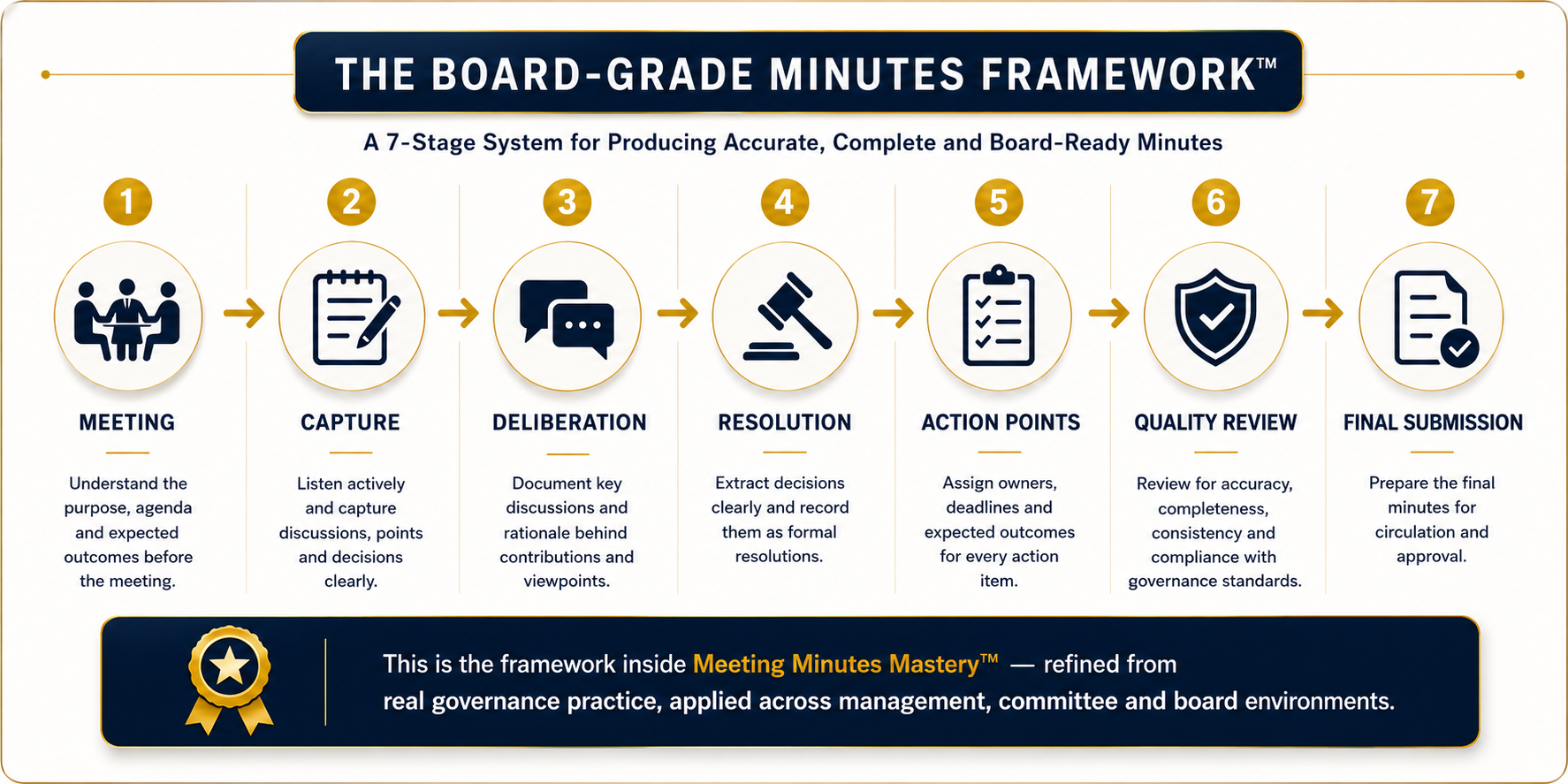
And then the requests started coming, from colleagues, fellow HR professionals, Administrative Officers, Secretariat staff across different organisations who were facing the same challenge I had faced and had no system to fall back on. I could not share the framework individually with everyone who needed it. So I built something better.